
Input 01 · Speed AI
Makes your people faster
Same work, less friction. An operating expense, like a software license — it belongs inside your rate.
You still bill by the hour, a flat fee, or a retainer. None of that speed shows up as margin. You're producing more value per engagement than you were a year ago — you're just not capturing more of it. The gap between what the work is now worth and what you keep is margin you have already earned and are not being paid for.
What your work is now worth, against what you are actually keeping.
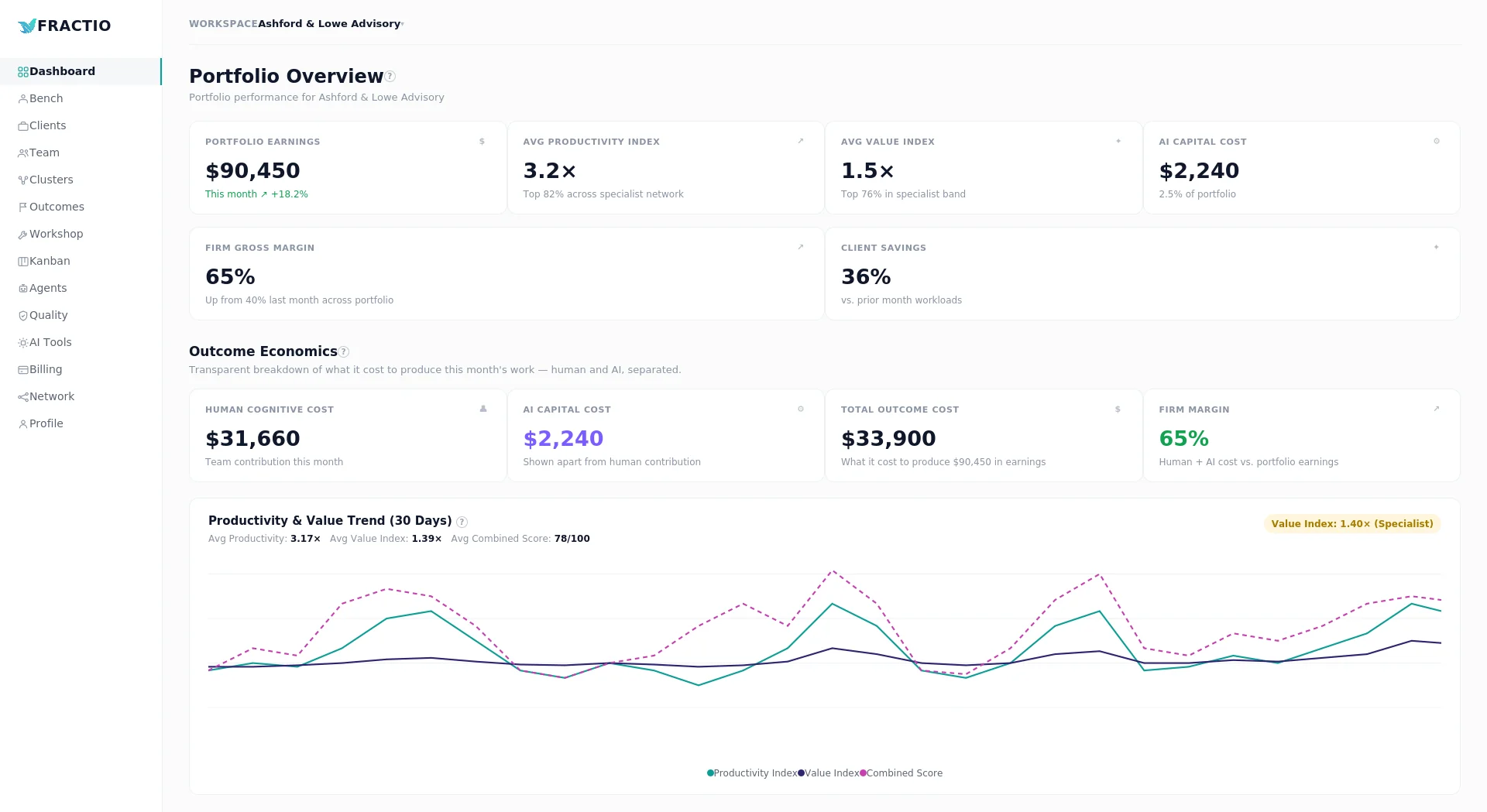
Human and AI cost, separated on the same outcome — the view your current tools can't produce.
Knowing your floor means you can drop your price to win the work and still know exactly what you keep.
They can't follow you down. Not because they're less capable — because they don't know their own floor, so matching you is a guess they can't price.
No professional services firm has ever competed on cost of goods, because the unit was an hour. Now there are two inputs, and only one of you can see both.
It proves the price is fair, and your rate holds. What you gain is four real choices you never had before — because you can now compete on the cost of delivering your own expertise.
You get them again every time the same workload runs.
Keep the gain as margin.
The verified production history behind your floor belongs to your workspace, and more runs tighten it.
Share it with the client as a lower price.
The delivery record is the proof, not the rate card.
Expand into more work for that client.
Priced from production history instead of estimation.
Scale to serve more clients with the same team.
When AI improves and your cost drops, your floor holds.
Your competitors don't compound. They re-estimate the same hour.
For a century, professional services assumed one input: human cognitive labor. That held until a second input entered the work and began producing output on its own. Your billing model treats them the same. It shouldn't.
Same work, less friction. An operating expense, like a software license — it belongs inside your rate.
A factor of production, not a capitalized asset — a second, distinct input with a real cost that has nothing to do with an associate's hour.
Two things are hiding inside a standard 40% margin: operational waste, and the cost of the AI doing part of the work. Attribution puts a number on both. Illustrative figures — the logic is the point, not the dollars.
AI is compressing hours inside this number right now. None of it is visible on the invoice.
Every wrapper hides this differently. None of them fix it.
The Fractio Outcome Settlement Fee applies to the full settled value once any margin is surfaced — not just the surfaced portion. It is charged when an outcome settles, so the firm pays it against value it has already been paid for.
Every verified unit of work adds to your production history, so the next run of the same workload is priced tighter than the last. That margin compounds every time this workload runs — and you get the same four choices on every run.
Fractio meters what your human experts contributed and what AI contributed on every unit of work, then prices each accordingly — routing the transaction through established economic and labor law so the price reflects the true value of both inputs before payment releases.
Every tool nearby is blind to this, each for a different reason. The knowledge your firm builds through Fractio is yours — it doesn't disappear when a subscription ends.
Every lane bills differently — retainer, fixed fee, T&M — but AI breaks each model the same way. SMB, mid-market, or enterprise, the fix is the same: attribute the two inputs before the invoice goes out.
The retainer is the dominant billing structure here — and hides the gap best. AI compresses hours on reconciliation, research, and drafting quarter over quarter.
Boutique through Big 4. Scoped, project-based expertise on fixed fee, SOW, or T&M. AI compresses hours inside the engagement; margin thins without anyone billing for it.
Solo and collective, as-needed on-demand leadership paid via retainer. The retainer holds while AI quietly absorbs the work behind it.
Dev shops competing on sprint delivery face the same problem one level down, inside the sprint.
Firms navigating the alternative-fee-arrangement trap hit the same problem under a different name.
Shared-services and internal teams face the same problem allocating cost to business units.
Fractio is pricing and settlement infrastructure for work built by people and AI. It meters what your experts and your AI each contributed to a unit of work, prices each input, and settles payment on its true cost.
Margin capture rate is the share of the value your work now produces that your firm actually keeps. Think of it like a realization rate — but for the value AI is compressing out of your hours.
Speed AI makes your people faster: same work, less friction. It is an operating expense, like a software license, and it belongs inside your rate. Capital AI produces part of the work itself. It is a capital input — a factor of production, not a capitalized asset — with a real cost that has nothing to do with an associate's hour.
No. What changes is what your firm knows about the cost underneath it. Revenue can stay the same while your margin capture rate rises, because waste is surfaced and AI capital is attributed. The four choices — keep it, share it, expand it, scale it — govern what happens next, and none of them requires reducing top-line revenue.
No. You don't have to change how you bill today. Fractio connects to your actual production data and surfaces exactly where value is being created but not captured.
Fractio sits in the middle of your stack and looks up at the finished outcome. Data comes in from your work management tools and your AI tools and agents. Fractio sees every input that built the outcome, from people and from AI, prices it and settles it, then passes that data on to your ERP, billing and payroll. Your tools keep doing their jobs. Fractio adds the one view none of them has.
Start with the Quick Scan: one type of work, your answers, about 20 minutes. Firms ready to go deeper move on to the Fractio True Cost Diagnostic.
You don't have to change how you bill today. Fractio connects to your actual production data and surfaces exactly where value is being created but not captured.